










inviting you to a growing table

We work with clients to listen and respond to their land with quantitative and qualitative data, bringing an ecosystem perspective to industrial and agricultural development and long-term management. Our focus is on increasing productivity and vitality by focusing on the ‘edges’ — the relationship between the land and the surrounding ecosystems — for multi-generational returns.
Return on Ecology is a team of experts who have all spent between one and five decades working at the interface between urban-and-agricultural development and conservation. We have noticed, over these decades, that our individual activities bring the highest returns with a cohesive approach.
We have thus organised into a collective, facilitating holistic land development, and unified responses to disturbances like
- pollution,
- eutrophication,
- degraded soil quality,
- waste management, or
- social and governance tensions.
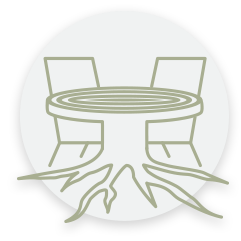
Our collaboration is rooted in trust and mutual respect, earned over time, and our common goals are the foundation of this institute. As our logo suggests, we invite you to a growing table to gather, discuss and design your activities, in partnership with nature.


Inviting you to agrowing table
We work with clients to listen
and respond to their land with
quantitative and qualitative data, bringing an ecosystem perspective to industrial and agricultural development and long-term management. Our focus is on increasing productivity and vitality by focusing on the ‘edges’ — the relationship between the land and the surrounding ecosystems — for multi-generational returns.
Return on Ecology is a team of experts who have all spent between one and five decades working at the interface between urban-and-agricultural development and conservation. We have noticed, over these decades, that our individual activities bring the highest returns with a cohesive approach.
We have thus organised into a collective, facilitating holistic land development, and unified responses to disturbances like
- pollution,
- eutrophication,
- degraded soil quality,
- waste management, or
- social and governance tensions.
Our collaboration is rooted in trust and mutual respect, earned over time, and our common goals are the foundation of this institute. As our logo suggests, we invite you to a growing table to gather, discuss and design your activities, in partnership with nature.
focus on the highest returns

Return on Ecology is a conservation effort that harnesses the potential of industry, agriculture and urban development as part of the natural ecosystem. We view human activities as a well-spring of conservation opportunities, not in conflict with nature but in collaboration with the surrounding ecosystem services. However, to partner with nature is to listen and respond to the whole system, consistently and patiently, over years.


We maintain that there are many regenerative leaders in Southern Africa. We define regenerative activities as any business-level activities that are in balance with the surrounding ecosystems, and which leave the ecosystems and people healthier.
Currently, the only recognition for such activities is in market-driven, competitive certification bodies. This allows for auditing and advertising, but the data is used for compliance and competition. Often farmers, developers or business owners do not have the support to rigorously interpret this data, or attractively communicate it.
According the Oxford English Dictionary, the word ‘develop’ stems from the Old French words ‘desveloper‘ or ‘désvelopper‘, meaning to ‘unfurl’, ‘unwrap’ or ‘unveil’.
Return on Ecology aims to support local regenerative leaders, by ‘unveiling’ the work they are doing. We assist farmers, developers and businesses in
(1) DATA MANAGEMENT: designing trials to prove the benefits of regenerative activities (controls, replicates, measurement protocols), co-creating data monitoring plans and databases, and
(2) SCIENCE COMMUNICATION: pulling the most relevant stories from the data, to harness this excellence for marketing and local collaboration.
Conservation has historically focussed on protecting intact ecosystems. We propose that ecosystem approaches can be integrated into development strategies, providing win-win solutions for agricultural production, urban design and nature conservation.
Return on Ecology is a registered non-profit company, a one-stop-shop assisting land managers in farming, industry and development to design fit-for-land approaches. We bring land development and conservation together, with a focus on the highest returns.


Financial Health
Rooted in the Economy, Designed for Returns

Conservation efforts have consistently been positioned against financial activities. Many ‘green’ strategies fail, because of purist conservation approaches. Particularly in the poverty-stricken context of Southern Africa, we maintain that a healthy financial model is the only route to a healthy ecosystem. Thus, we provide data-based strategies for ecosystem health, but each is
- quantified: first weighted in a cost-benefit analysis,
- prioritised: designed to be manageable within the business financial model, and
- malleable: designed as an experimental hypothesis, that is tested with small, financially safe steps over time.
We also serve as a platform for regenerative leaders to share experiences between land managers, to avoid reinventing wheels and ‘paying the school fees’ repeatedly.

Context
Fit-for-Land Approach
Conservation in urban and agricultural development has been implemented through regulation, and expensive and performative corporate certification. Bureaucracy restricts creative trial-and-error conservation activities.
This purist approach does not facilitate co-creation with the environment and each other.
For example, a farmer re-using waste might lose his access to the organic market, despite limiting as many chemicals as an organic farmer whilst also adding waste circularity. Or a farmer that introduces an avian flock for pest control may be forced to use a fungicide in one particularly humid year, forfeiting her access to traditional certification processes.
A simple change in purpose alleviates this pressure:
By working to evaluate activities rigorously and communicate them attractively and openly, Return on Ecology facilitates context-driven regenerative activities. This data management strategy offers grace for contextual nuances.

Context
Fit-for-Land Approach
Conservation in urban and agricultural development has been implemented through regulation, and expensive and performative corporate certification. Bureaucracy restricts creative trial-and-error conservation activities.
This purist approach does not facilitate co-creation with the environment and each other.
For example, a farmer re-using waste might lose his access to the organic market, despite limiting as many chemicals as an organic farmer whilst also adding waste circularity. Or a farmer that introduces an avian flock for pest control may be forced to use a fungicide in one particularly humid year, forfeiting her access to traditional certification processes.
A simple change in purpose alleviates this pressure:
By working to evaluate activities rigorously and communicate them attractively and openly, Return on Ecology facilitates context-driven regenerative activities. This data management strategy offers grace for contextual nuances.

Caring for the Edges
Ecology and Returns at the Interfaces
Biological life is most abundant at the interfaces. The same can be said for society. We are most formed at the interfaces: when we relationally meet the other, at the edge of ourselves.
In the same vein, Return on Ecology improves the returns of land management by focusing on the neglected edges.
We work with wastes, with integrating the systems, and with marginal land. We farm the fence lines and introduce nuanced biomimicry (herding, plant diversity, waste circularity, energy and waste engineering). We also monitor and communicate the positive effects of business activities on the surrounding ecosystem.
The interface between business resources and the surrounding natural resources hold long-term profit.


Legacy
Multi-Generational Returns
We design inheritance strategies, ownership transfers and long-term sustainability into our land management strategies.
Industry and agriculture are time-intensive and labour-intensive. There is often not capacity for legacy planning. Thus, enterprises often respond to discrete data (collected at a moment, or in a short phase in time) rather than continuous data (gathered, interpreted and stored with rigorous metadata for long-term value addition to land management).
Our work is informed by the legacy plans of each urban or agricultural activity. We facilitate data management, interpretation and access. Longevity and data transfer is an overarching goal.
This also allows for transparency, allowing clients and neighbours to peer into the effects and struggles of excellence.
Our aim is to leave the soil, water, and surrounding ecosystem in better condition than when the development activities began.

On-the-Ground Knowledge Transfer
Capturing and Transferring Experience

We have noticed that the young workforce in urban and agricultural planning and development is currently informed by valuable but complex tertiary degree programs. However, there is a generation of consultants, farmers, water and waste specialists, and conservationists on the brink of retirement, who have a different type of knowledge that has emerged from decades of hands-on experience.
Many of the ground-level workforce on farms, in businesses, and on development sites require small bites of practical knowledge, that can be facilitated with a few short conversations and some connections between the local experts.
This serves:
- digital nomads and businesspeople who are considering farming, with a generational break in knowledge,
- farm-level workforces without tertiary education, but requiring continuing knowledge development in land and resource management from an ecosystems perspective, and
- businesses and farms that require support in systems-thinking.
This Institute is the platform to capture and transfer the hands-on knowledge of established consultants and practitioners, for this market. Our table includes seasoned practitioners in agriculture, waste, water, conservation and education.
We host short workshops — in response to needs in the landscape — on irrigation, fertilisation, water and waste management, air quality control, and biodiversity strategies like animal herding and indigenous cover cropping, amongst others.
We are also associated with multiple educational organisations including the Environmental Leadership Academy and Stellenbosch University (see Advisory Team), providing opportunities for postgraduate projects in regenerative development.


Relational Ecosystems
Connecting the People
The activities of the people — relational, regulatory, industrial, commercial, and agricultural — are considered an integral part of RoE’s ecological strategies.
‘The world functions in wholes whose qualities cannot be predicted by studying any aspect in isolation; one has to see the whole first. We would know very little about water, for instance, by making an exhaustive study of hydrogen or oxygen, even though every molecule of water is composed of both. Likewise, we could never manage a piece of land in isolation from the people who work it or the economy in which both the land and the people are enmeshed.’ – Smuts, 1927
As much as biodiversity is a focus — as we introduce grazing animals to monoculture farms, or invite insect species through indigenous inter-cropping informed by local eco-regions — relational diversity also is a strong value. We consider relational health a central tenant in designing healthy activities in sustainable balance with the natural ecosystem.
Generous and co-creative interpersonal relationships inherently scale our impact.
Our approach focuses on building relationships with:
- government and regulatory bodies (our work is not regulatory, but is designed in relationship with regulators),
- the market (clear branding that engages consumers in our regenerative activities and philosophies),
- the community (regenerative co-creation crossing ethnic, economic and cultural divides),
- farm and business labour forces (engaging the hands-on knowledge of seasonal labourers and on-the-ground workforces), and
- neighbours (establishing cohesive regenerative strategies with neighbours, creating biodiversity corridors).

Knowledge Ecosystems
Communicating a Nation-Wide Experiment
Currently, regenerative activities have a reputation for not being lucrative or effective, in tension with the market and the economy. There are thousands of research articles and popular media reports, with conflicting conclusions.
There are also many rigorous and pioneering regenerative activities across South Africa, on farms and in businesses.
However, quantitative and measurable conclusions are hamstrung by the complexities of regenerative work, including:
- evolving vocabulary (debated definitions),
- complexity (inherent in-field variability),
- experimental design (lack of controls and statistical replicates),
- consolidation and standardisation (multiple repositories and individual methodology preferences), and
- community connections and access to information (many are eager to share experiences, but newcomers do not always have relational access to established pioneers).
Essentially, a nation-wide experiment is emerging, across businesses and farms, with regenerative excellence creating biocorridors of ecological health. However, the data is not being standardised, interpreted or shared.
Return on Ecology is developing an audited, standardised and rigorous database, communicating key stories on a tagged, categorised and searchable website. This is organised according to
- field (Vinecology®, Olive-ecology®, Citrus-ecology®, or Urban-Ecology®),
- establishment (farm or business enterprise), and
- regenerative activity (intensive intercrop herding, cover crops, waste engineering, waste circularity, etc.).
For each regenerative activity that a farmer or business owner is trialling, we report:
- scientific impacts (one to two graphs, cost-effective and relevant parameters),
- economic impact (one table),
- carbon impact (one table),
- narrative (three ‘What do I need to know?’ sentences, about managing the regenerative activity), and
- contact details (the manager).
This database and online communication platform are searchable, so that other farmers and developers can explore the ideas and speak to those who have ‘paid the school fees’, preventing reinventing the wheel.
It is a knowledge transfer platform creating arteries of relational accessibility for those designing regenerative work.


Propagation for wetland management

Multispecies Wetland Rehabilitation

Soil, Plant and Water Analyses

Wastewater Irrigation of Pastures

Cattle Herding through Crops and Wetlands

Herding for Soil Preparation

Indigenous Cover Crops in Vineyards

Intercrop Livestock Herding

Factory Fats and Oils Capture for Piggeries

Green Bedding from Livestock Dung

Sludge Settling Dams
Bring your story to our tableand let’s co-design your ecosystem strategies.
Bring your story toour table and let's co-designyour ecosystem strategies.


Wendy: +27 63 348 5727 or Bennie: +27 82 452 7263
Wendy: +27 63 348 5727 or
Bennie: +27 82 452 7263




Return on Ecology is a registered non-profit company, offering Section 18A tax receipts | CIPC Registration number K2025312852
Website designed by Bunnypants Graphic & Web Design Studio | 2025