The ‘About Us’ page on websites tells us much about the technical skills of any team. But, Return on Ecology is a collective drawn by desire, philosophy and culture, as much as our expertise. This piece explores each member’s reason for being at this table, using art and music.
Fertilizer Consultant and Regenerative Systems Designer (40 years experience)
‘Pasiphae and the Olive Tree’ by Henri Matisse (1944)
Return on Ecology’s work is experiential, relational and rooted in desire, as in Matisse’s embrace above.
We are exploring how to root science in the art of managing a piece of land. The simplicity of this work — at it’s most mature — should be entirely lost in the expression of the work. This is so eloquently described in Antoine de Saint-Exupéry’s Wind, Sand and Stars (1939):
“No doubt our house will gradually become more human. The more perfect machines become, the more they are invisible behind their function. It seems that all man’s industrial effort, all his calculations and his nights spent poring over drawings, all these visible signs have as their sole end the achievement of simplicity.
It is as if only the experimentation of several generations can define the curve of a column or a ship’s hull or an aeroplane fuselage, and give it the ultimate, elementary purity of the curve of a breast or a shoulder. On the surface it seems that the work of engineers, designers and research mathematicians consists only in polishing and refining, easing this joint and balancing that wing until there is no longer a wing joined visibly to a fuselage, but a perfectly developed form freed at last from its matrix, a spontaneous and mysterious whole with the unified quality of a poem. It seems that perfection is attained not when there is nothing more to add, but when there is nothing more to take away. At the climax of its evolution, the machine conceals itself entirely.
Thus the perfection of invention amounts to an absence of invention.”
Bennie reflects, “I have been grappling with a quote that describes our work in developmental ecology: ‘Our environment is an extension of our immune system‘. I am struck by the word, ‘our’. And also struck that we do not notice the workings of our immunity until it collapses. The worlds within worlds that make up our ecosystem — our immunity — are biological, physical, and psychological. These are the worlds we tend to, in Return on Ecology.”
Pair this with the 1993 album by the Irish band, Hothouse Flowers: Songs from the Rain.
Conservationist and Landscaper (20 years experience)
A family photo taken by Shelly (Kogelberg Nature Reserve, 2017)
Shelly describes, “This photo represents everything I am meant to be doing: working day-by-day to protect, restore and enjoy rivers, mountains, family and fynbos. As Margaret Mead said, ‘Never doubt that a small group of thoughtful, committed citizens can change the world; indeed it’s the only thing that ever has.’”
‘Rivers and Tides: Working with Time’ by Andy Goldsworthy (2001)
“Movement, change, light, growth and decay are the lifeblood of nature, the energies that I try to tap through my work. I need the shock of touch, the resistance of place, materials and weather, the earth as my source. Nature is in a state of change and that change is the key to understanding. I want my art to be sensitive and alert to changes in material, season and weather. Each work grows, stays, decays. Process and decay are implicit. Transience in my work reflects what I find in nature.”
-Andy Goldsworthy
From Shelly: “This international artist moves me, making temporary creations intended to highlight both the contrasts in beauty and the balance that is so intrinsic to natural cycles. But my grandmother and mom are the nature artists from whom I learned my love of gardening, and being in nature. That is my favourite palette, one where I am constantly inspired to be creative and to experiment. I started off my career as a landscaper, so I love using plants and contours to create outdoor spaces that others can enjoy as they grow and evolve over time.”
Pair this with U2’s song, ‘Trying to Throw Your Arms Around the World‘, see below.
“The lyrics summarise this for me: ‘It’s one life, and we get to share it. We’re one – but we’re not the same. We get to carry each other.‘
Return on Ecology is a community, carrying each other as partners, friends, students, advisors. I often want to throw my arms around the world: I’m a big hugger – rather than a handshake. So next time we meet, be ready for me throwing my arms around you!”
Citrus Production; Soil, Water & Plant Quality Testing (30 years experience)
With long experience in crop production, as well as directing a soil, water and plant quality testing laboratory, Pieter is the voice of reason: challenging entrenched views in data. He is as cautious to query out-dated assumptions about data interpretation as he is to query over-simplified ecological trends.
A recent article — ‘How Pop Ecology Misleads Agriculture‘ (linked here) — by Andrew McGuire from the Center for Sustaining Agriculture and Natural Resources emphasises the risk of over-simplifying the process of integrating biodiversity into agricultural production systems.
‘Pop ecology assumes a form of crop production that “works like nature” is not only possible but achievable, and that it offers a simple prescription to fix farming. Breaking free from this unfounded eco-optimism requires three fundamental shifts in how we think about farming. Call it the unpopular ecology of reality—unpopular because it trades comforting narratives for harder truths:
(1) we often don’t have an accurate view of nature itself, (2) unmanaged nature cannot feed us, and (3) the best guard against pop ecology is one truth: in agriculture, there are no solutions, only tradeoffs.‘
‘There are always tradeoffs: between crop yields and nutrient use efficiency; between concentrated, highly productive fields and pest pressure; between planting and harvest efficiency and the benefits of crop diversity. These tradeoffs involve markets, regulations, soil types, crop requirements, equipment costs, and countless other factors. Figuring out the best management while balancing these constantly shifting variables means making choices—some that won’t favor environmental ideals.
Wise farmers and consultants embrace this unpopular ecology of reality—seeing crop production clearly as a distinct system requiring informed, active management based on what actually works in their fields, not what sounds appealing in theory. Reality is messier and less generalizable than pop ecology promises, but it’s the reality we must work with.’
Pieter reminds us that Return on Ecology is not promoting ecological ideals, but grappling with the messy reality of the interface between ecology and development, in a feedback loop of trial and error with those who care.
This Calvin & Hobbs cartoon is also close to his heart, reminding us of the other side of the coin: how quickly our rigorous science can make simple work too complicated.
In an article on soil biology in the 90’s, Pieter wrote, ‘In circa 1500 Leonardo da Vinci said: ”We know more about the movement of celestial bodies than about the soil underfoot‘. Pieter reminds us to hold onto both sides of the eternal tension of data interpretation in soil and ecological management: gritty, rigorous realism along with curiosity and humility.
Pair this with Marvin Gaye’s ‘Mercy Mercy Me‘ (The Ecology)
Water and Soil Quality, Circular Waste Management (10 years experience)
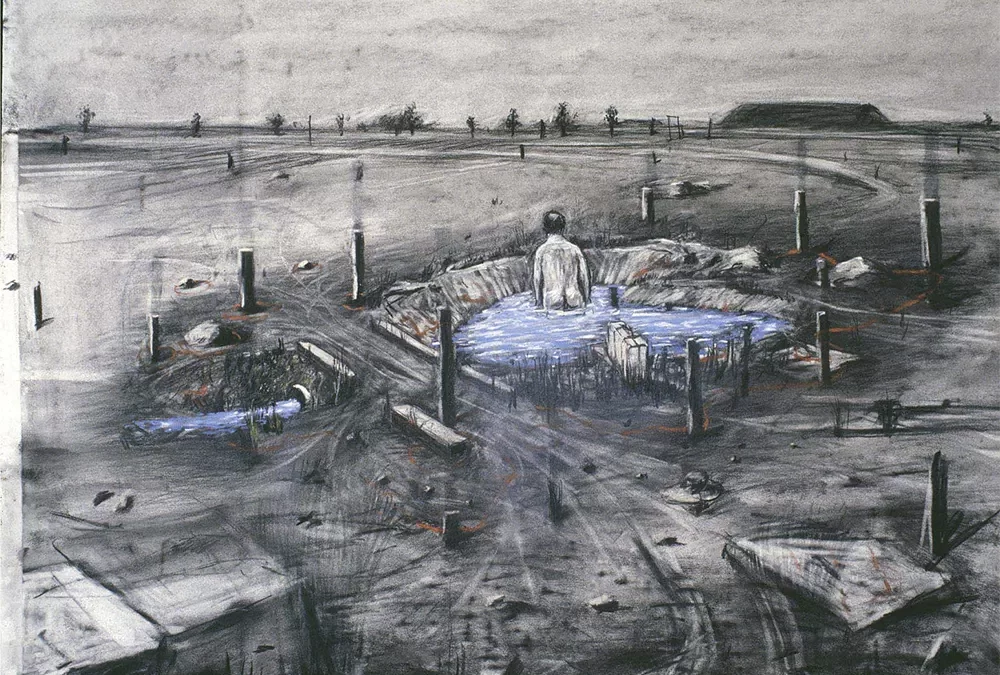
‘The heart has it’s own memory’ William Kentridge exhibition (2016)
William Kentridge expresses his process as ‘ambiguity, contradiction, uncompleted gestures and uncertain endings’ to hold both optimism and nihilism in check. He has said that the ‘absurd is a productive way to understand a world where certainty often leads to disaster.’
Wendy reflects, “In Return on Ecology, I find space to explore less certainty, as I grapple with knowledge. I have worked in riverine systems and long grappled with years of catching hope, and years of sensing it slip away. Kentridge expresses the full reality, the grit of the South African socio-political landscape — and yet, whispers of hope break through as nature seeps through his cities and landscapes: encounters with small flashes of beauty in a stark reality.”
‘The heart has it’s own memory’ William Kentridge exhibition (2016)
“As I’ve grappled with hope, many authors have reminded me that it is surprising, it is revolutionary, and it is only encountered together.
‘People have always been good at imagining the end of the world, which is much easier to picture than the strange sidelong paths of change in a world without end.‘
‘Authentic hope requires clarity—seeing the troubles in this world—and imagination, seeing what might lie beyond these situations that are perhaps not inevitable and immutable.’
– Rebecca Solnit, Hope in the Dark (2004)
Desmond Tutu himself tells of his hope before Apartheid fell. He called it ‘whistling in the dark‘, when asked by a journalist whether he knew the end would come:
‘Well, I’ll tell you something. In January this year I was asked by one of the TV crews what my New Year’s resolution was. I had answered somewhat gleefully, ‘I want to improve my dance routine because I think we will be doing quite a lot of celebrating this year.’ Perhaps it was wishful thinking, a little bit of whistling in the dark. But, you know, I also knew God was around, what with the Berlin wall coming down and freedom breaking out all over.‘ – Tutu in ‘A Politics of Love’ (1990)
Pair this with Risha Lötter’s acoustic version of Nakho and the Medicine Man’s ‘We are on Time‘ (original and cover below). She is a local artist, living and working in Knysna. This song captures the depth of relationship I experience with the natural world, this team, and our partners: the intimacy we are building, the consistency, the harmonies as we whistle together in the dark. The song captures the long-term relational health necessary to build a home.
“I am on your side, I am not drawing a line, only want what is right, what is best for your life.”
“Meet me in the streets, in the dark, in your bare feet, meet at a place where your heart drops a deep beat”
We use cookies to enhance your experience and analyze traffic. By continuing, you agree to our use of cookies.
Functional
Always active
The technical storage or access is strictly necessary for the legitimate purpose of enabling the use of a specific service explicitly requested by the subscriber or user, or for the sole purpose of carrying out the transmission of a communication over an electronic communications network.
Preferences
The technical storage or access is necessary for the legitimate purpose of storing preferences that are not requested by the subscriber or user.
Statistics
The technical storage or access that is used exclusively for statistical purposes.The technical storage or access that is used exclusively for anonymous statistical purposes. Without a subpoena, voluntary compliance on the part of your Internet Service Provider, or additional records from a third party, information stored or retrieved for this purpose alone cannot usually be used to identify you.
Marketing
The technical storage or access is required to create user profiles to send advertising, or to track the user on a website or across several websites for similar marketing purposes.